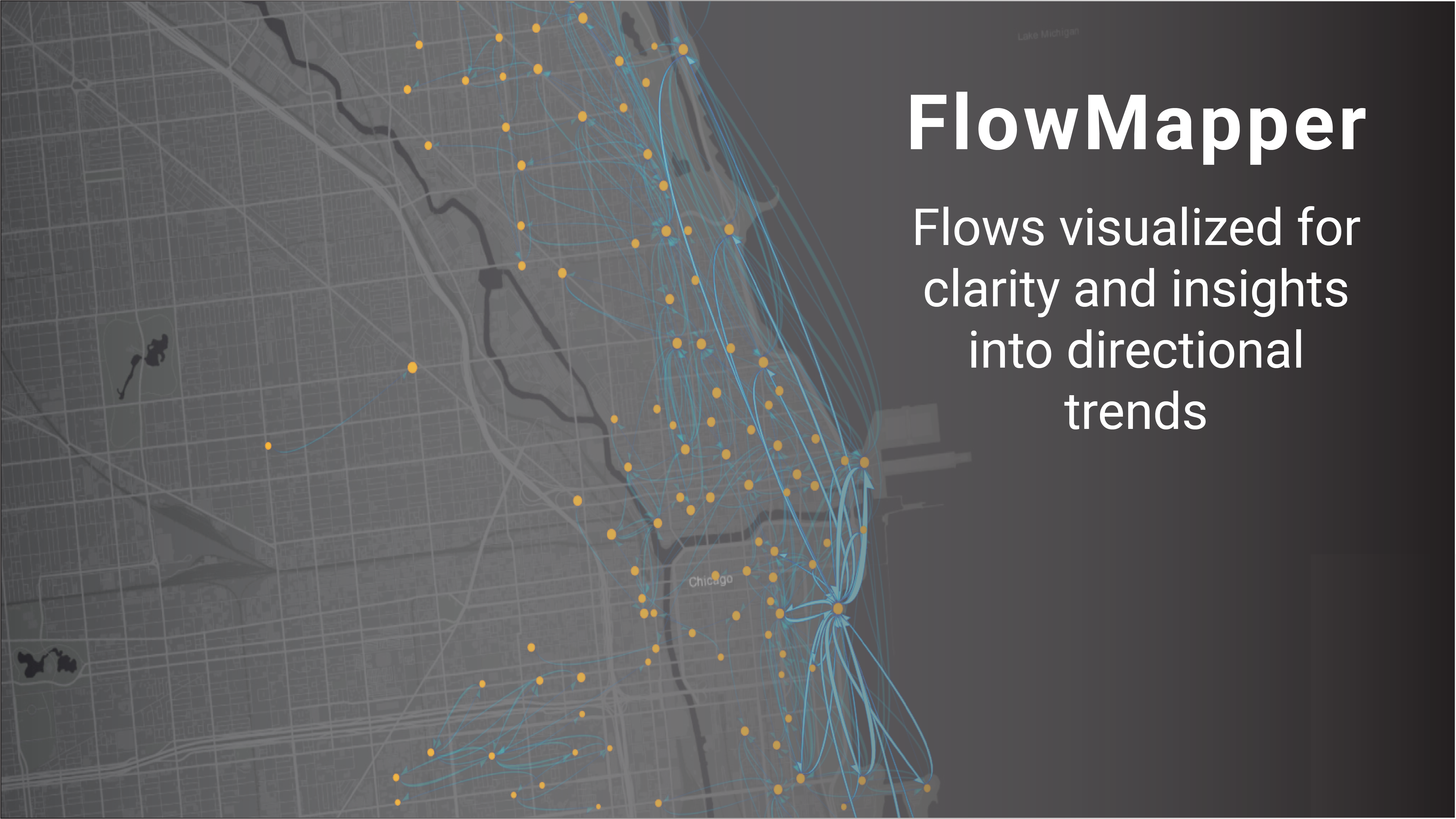
Polygons To Points
This tool converts a GeoJSON, TopoJSON or shapefile polygon file to the "Nodes" CSV file
with longitude and latitude coordinates of polygons centroids. For a shapefile choose one .zip, or select
the .shp, .shx, .dbf and .prj files together. Click "Submit" to download the file to your browser's
download folder.
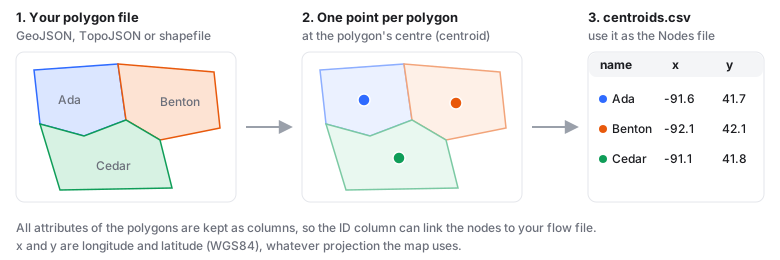
Flow Matrix to Flow List
This tool converts a CSV file containing a flow matrix into a flow list CSV file with columns for origin, destination, and volume. Select the orientation of the matrix and click "Submit" to download the flow CSV file to your browser's download folder.
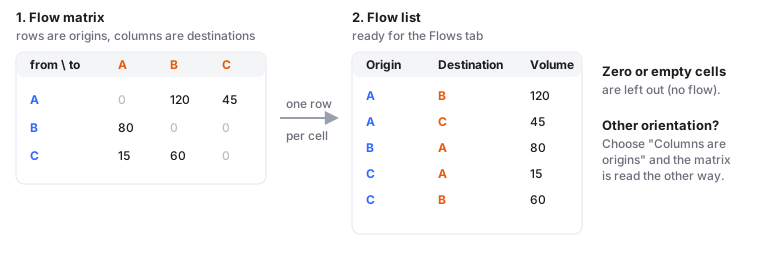
Flow Matrix Orientation
Regionalization alpha
What it does. A map with hundreds of flows is hard to read. This tool groups places into regions by community detection: it finds groups of places that exchange much more flow with each other than expected, by maximizing modularity. Each community becomes one region, and the flows are added up between regions, so the main patterns stand out with far fewer flow lines. Everything runs in your browser.
Methods. ScLeiden (the default) and ScLouvain are the spatially constrained versions of the Leiden and Louvain algorithms (Wang, Wang & Onega 2021): every region is one contiguous area, and regions smaller than a minimum size are merged into a neighbour. Leiden and Louvain use the flows only, so a community can be spread over several separate areas.
1. Load the node and flow files in the Nodes and Flows tabs and choose their fields. Optionally load region polygons (Regions tab) whose IDs match the node IDs: they give exact boundaries and neighbours.
2. Settings.
| Method | |||
| Resolution | higher = more, smaller regions; lower = fewer, larger ones | ||
| Runs | Random seed | ||
| Randomness θ | Leiden refinement; 0.01 as in Wang et al. (0 = always the best merge) | ||
| Minimum region size | measured as | ||
| Region boundaries | |||
| Region node | |||
Region node: the point that stands for a region. The flow-weighted centre of a spread-out or curved region can fall outside it, even inside another region; the default then uses the member place with the smallest flow-weighted distance to all other members, which is always inside the region.
Flow Coordinates to Nodes
What it does. Some flow files describe each flow by the coordinates of where it starts and where it ends (for example o_x, o_y, d_x, d_y, volume) instead of by place names or IDs. FlowMapper needs two linked files: a Nodes file that lists every location once with an ID, and a Flows file that says which node each flow goes from and to. This tool finds every distinct location in your flow file, gives it an ID, and creates both files for you.
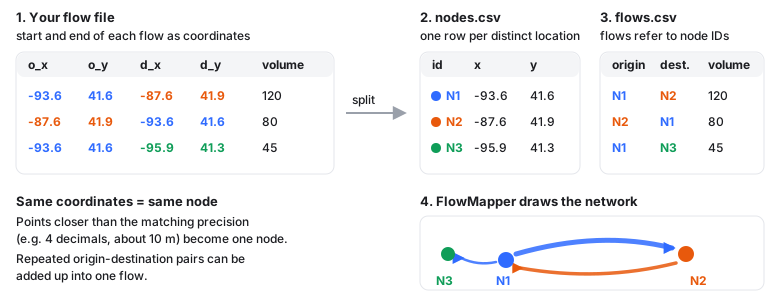
1. Choose your flow CSV file. Coordinates should be longitude (x) and latitude (y) in decimal degrees.
Normalize Flows
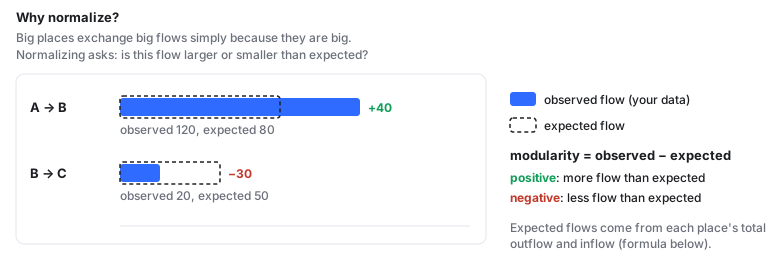
Flow normalization helps remove the effect of total flow or population size by
calculating modularity, i.e., the difference between the actual flow and the expected volume of flow for
each pair of locations (nodes). We use the adjusted flow volume formula below to calculate the expected
number of flows between locations.
For more details in modularity function please refer to Guo
(2009).

1. Select your flow file with columns: origin, destination, and volume, then click
"Submit".
2. Once processed, your file will be downloaded into your browser's download folder.
It will have columns for origin, destination, modularity, rawvolume, and expectation. The modularity
column reflects the difference between observed (rawvolume) and expected flow (expectation) using the
given formula.
3. Modularity can be negative or positive. Negative values indicate fewer observed
flows, while positive values suggest more observed flows than expected between origins and
destinations.
Calculate Node Measures
Node measures calculated from flow data facilitate the creation of custom choropleth
base map and node symbol map to provide context into the importance of nodes in the spatial network.
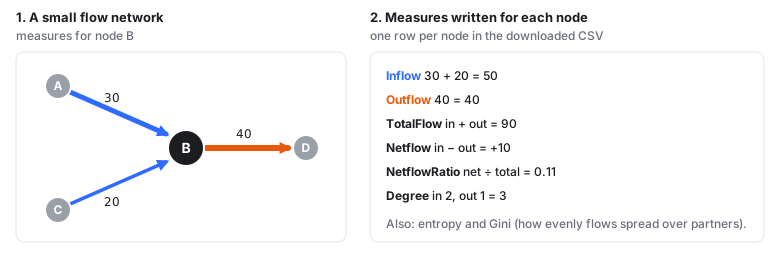
These measures currently include gross (total) flow, inflow, outflow, net flow,
entropy, Gini coefficients, and degree measures. Koylu & Guo (2013).
1. Select your flow file with columns: origin, destination, and volume, then click
"Submit".
2. Once processed, node measures file will be downloaded into your browser's download
folder in a csv format that contains the nodeids that exist in the flow file and the basic node measures
listed above.
3. You could join the node measure file to the choropleth or node symbol map to
customize the symbology to reflect the selected measure.
Test Server Connection (beta)
This is a testing tool to connect to the backend Java code, which will provide more
complicated analysis tools for pre-processing your data before visualization.
Only for testing use! please input your file below:
Testing result:
Help
Video tutorial
A walk-through of making a flow map with FlowMapper.
Tutorial data
Example data sets are available to download and map with FlowMapper.
Get the example data on GitHub
Try it in four steps
- Regions (optional): upload the polygon file, GeoJSON, TopoJSON or a shapefile.
- Nodes: upload the node CSV, one row per place with an ID and its longitude and latitude.
- Flows: upload the flow CSV with origin ID, destination ID and volume.
- Check the fields FlowMapper selected for you, then click Map in each tab.
Contact us
We are glad to help you use FlowMapper and welcome your feedback. Write to us at geo-social@uiowa.edu.
Report a problem
Tell us what you did, what you expected and what happened. A screenshot, your browser name and, if possible, the project file (File > Project > Save Project) help us find the cause quickly.
Suggest a feature
Missing a map projection, a flow style, a color scheme or an analysis tool? Describe what you would like to map and we will consider adding it.
Get help with your data
Not sure how to format your node and flow files? Start with the example data sets, or send us a few rows of your files.
Resources
- Example data: github.com/geo-social/flowmapper
- Video tutorial: Help > Video Tutorial
- Geosocial Lab, University of Iowa: www.geo-social.com

FlowMapper
Design origin-destination flow maps in your browser.
Team
- Caglar Koylu
- Supervisor and developer
- Geng Tian
- Developer, 2020–2022
- Maeve Biscupski
- Developer, June–October 2023
- Claude
- Anthropic's AI model, developer since November 2026
How to cite
Please cite this article if you use FlowMapper in a manuscript or any other publication.
Koylu, C., Tian, G., & Windsor, M. (2023). FlowMapper.org: A web-based framework for designing origin-destination flow maps. Journal of Maps, 19(1). https://doi.org/10.1080/17445647.2021.1996479
| Base Map: | |
|
|
|
| Base map opacity(%): | |
| Projection: | |
|
|
|
| Title size: | |
| Title color: | |
|
|
|
|
|
|
|
|
|
|
|
|
| Reference Field: | |
| Font size: | |
| Label radius: | |
| Label color: | |
| Opacity (%): | |
|
|
|
| Upload Polygon Data: | |
|
GeoJSON, TopoJSON, or a shapefile: one .zip, or select the
.shp, .shx, .dbf and .prj files together (plus .cpg if you have it).
|
|
|
|
|
| Fill: | |
| Attribute source: | |
| Join CSV Data: | |
|
|
|
| Polygon ID Field: | |
| CSV ID Field: | |
| Map Field: | |
| Classification: | |
| Manual break setting: | |
| Color scheme: | |
| Min color: | |
| Max color: | |
| # of classes: | |
| Fill opacity (%): | |
| Stroke color: | |
| Stroke width: | |
|
|
|
| Legend title: | |
| Decimal places: | |
| Node Data: |
|
|
|
|
|
|
|
| # of classes: | |
| Manual breaks setting: |
|
| Fill color: | |
| Min Color: | |
| Max Color: | |
| Fill: | |
| Fill opacity (%): | |
| Radius: | |
| Min radius: | |
| Max radius: | |
| Stroke color: | |
| Stroke width: | |
|
|
|
| Legend title: | |
| Decimal places: | |
| Flow Data: | |
| Origin ID: | |
| Destination ID: | |
| Volume: | |
| Show top flows: | |
| Style: | |
| Classification: | |
| # of classes: | |
| Color:
|
|
| Fill opacity (%): | |
| Min color: | |
| Max color: | |
| Min width: | |
| Max width: | |
| Stroke color: | |
| Stroke width: | |
|
|
|
| Legend title: | |
| Decimal places: | |
Something needs attention
Error.
Nodes and flows do not match
None of the flows' origin or destination IDs were found among the node IDs, so there is nothing to draw.
- Nodes tab: the ID field must hold the same values as the flow origins and destinations (for example state codes in both files).
- Flows tab: check the Origin and Destination fields.
- Check that both files are the ones you meant to load.
Region join results
How many polygons found a matching row in the CSV table.